Attachment theory, developed by John Bowlby and Mary Ainsworth, describes how early relationships with caregivers shape the way people connect with others throughout life. The patterns developed in early childhood become templates for adult relationships: how close we allow others to get, how we respond when relationships feel threatened, how we manage the fundamental human tension between needing connection and needing independence.
The four types of attachment- secure, anxious, avoidant, and disorganized- describe not a fixed personality but a learned relational strategy. Because these patterns are learned, they can also be changed. Understanding which attachment pattern you carry, and where it came from, is often the beginning of the most important work in therapy.
If you recognize attachment issues in yourself or in your relationships, CBH’s South Florida clinical team provides comprehensive mental health treatment that addresses attachment patterns directly. Call 844-503-0126 for a free assessment.
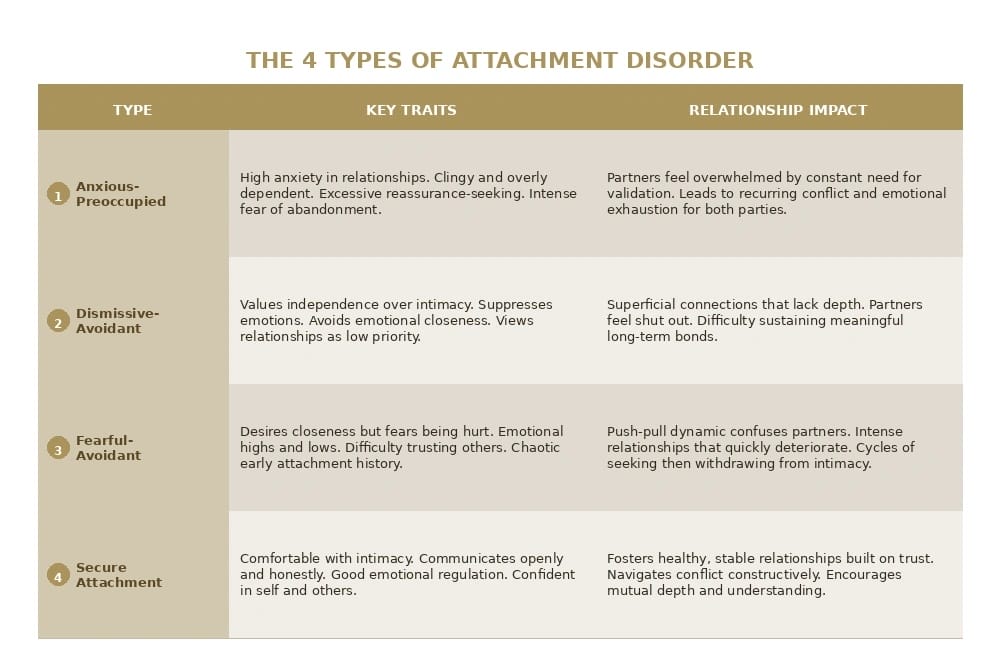
The 4 Types of Attachment Disorder at a Glance
The following table compares the four attachment styles across their core features.
| Feature | Secure | Anxious (Preoccupied) | Avoidant (Dismissive) | Disorganized (Fearful) |
| Core fear | Few; trusts relationships | Abandonment, rejection | Intimacy, vulnerability | Abandonment AND intimacy |
| Self view | Positive, worthy of love | Negative, not enough | Positive, self-reliant | Deeply negative, defective |
| View of others | Trustworthy, reliable | Idealized or devaluing | Untrustworthy, intrusive | Both needed and frightening |
| In relationships | Comfortable with closeness | Clingy, needs reassurance | Emotionally distant | Push-pull, chaotic |
| Under stress | Seeks comfort from others | Escalates anxiety, seeks contact | Withdraws, becomes self-sufficient | Disorganized, may freeze or collapse |
| Origin | Consistent, attuned caregiving | Inconsistent caregiving | Emotionally unavailable caregivers | Frightening or abusive caregivers |
| Treatment focus | N/A, generally healthy | Developing security, self-worth | Building emotional availability | Trauma processing, safety building |
If you recognize your attachment pattern in this table, CBH’s South Florida clinical team provides therapy that directly addresses attachment issues in adults and the relationship patterns they produce. Call 844-503-0126. All calls are completely confidential.

What Is Attachment Disorder?
Attachment disorder refers to the difficulties in forming healthy emotional bonds with others that result from disrupted early attachment experiences. In clinical terminology, Reactive Attachment Disorder (RAD) and Disinhibited Social Engagement Disorder (DSED) are the formal childhood diagnoses. In adult clinical practice, the term attachment disorder or attachment issues more broadly refers to the insecure attachment patterns, anxious, avoidant, and disorganized, that develop from early relational experiences and persist into adult relationships.
Attachment issues are not a sign of weakness or a permanent character flaw. They are the learned strategies of a nervous system that adapted to the caregiving environment it experienced. A child with inconsistent caregivers learns that love requires constant pursuit. A child with emotionally unavailable caregivers learns that needing people leads to disappointment. A child with frightening or abusive caregivers learns that the people who are supposed to provide safety are also the source of danger. These strategies were adaptive in the original environment. They become problematic when they persist unchanged into adult relationships where the caregiving environment no longer applies.
Attachment Disorder Types: The Four Patterns
The four attachment patterns describe four different ways the nervous system learned to manage the fundamental need for connection. Three are insecure adaptations; one represents secure attachment that most people do not have as a baseline but can develop through therapy and corrective relational experiences.
Type 1: Secure Attachment
Secure attachment develops when caregivers are consistently responsive, attuned, and available. The child learns that their needs will be met, that they are worthy of care, and that other people are reliable sources of comfort and support. This early learning produces a relational template in which intimacy is safe, independence is possible without anxiety, and conflict can be navigated without threatening the relationship.
Adults with secure attachment are comfortable with closeness and with independence. They can depend on others without losing themselves and can be depended on without feeling trapped. They manage conflict constructively, communicate needs directly, and recover from relationship ruptures without excessive anxiety or avoidance. Secure attachment is the goal of attachment-focused therapy, not the starting point for most people who seek it.
Type 2: Anxious Attachment (Preoccupied Attachment)
Anxious attachment, also called preoccupied attachment in adults, develops from inconsistent or unpredictable caregiving. When a caregiver is sometimes attuned and sometimes not, sometimes available and sometimes absent, the child learns that love is uncertain and that vigilant pursuit is necessary to maintain access to care. The nervous system develops a heightened sensitivity to any sign that the attachment figure might be withdrawing.
Signs of Anxious Attachment in Adults
- Intense fear of abandonment that affects relationships disproportionately
- Strong need for reassurance about the partner’s feelings and commitment
- Difficulty being alone or self-soothing without a relationship
- Hypervigilance to signs that the partner is distancing or losing interest
- Tendency to prioritize the relationship over personal needs and identity
- Escalating anxiety or anger when the partner needs space or independence
- Pattern of choosing partners who are inconsistent or emotionally unavailable, recreating the original attachment dynamic
Anxious Attachment in Relationships
Adults with anxious attachment often experience relationships as the central organizing feature of their lives, for better and worse. The intensity of connection they are capable of can be a genuine gift in relationships. The anxiety that drives them to pursue closeness at the cost of their own needs can be exhausting and ultimately drives away the partners whose closeness is most wanted.
Anxious attachment is sometimes called the push that creates avoidant pull in relationships between anxiously and avoidantly attached people: the anxious partner’s pursuit activates the avoidant partner’s withdrawal, which intensifies the anxious partner’s pursuit. This cycle is one of the most common and most painful relationship dynamics in clinical practice.

Type 3: Avoidant Attachment (Dismissive Attachment)
Avoidant attachment, called dismissive attachment in adults, develops from caregivers who were emotionally unavailable, dismissive of emotional needs, or who communicated that dependency was undesirable. The child learns to suppress attachment needs and to rely on themselves to manage emotional experience, because turning to the caregiver for comfort reliably fails to produce comfort.
Signs of Avoidant Attachment in Adults
- Strong preference for independence and self-sufficiency in relationships
- Discomfort with emotional intimacy and vulnerability
- Tendency to withdraw when relationships become emotionally intense
- Difficulty identifying or expressing emotional needs
- Dismissal of emotional needs in self and sometimes in others
- Pattern of maintaining emotional distance even in committed relationships
- Feeling trapped or suffocated by partners who want more closeness
Attachment Detachment Disorder in Adults
What is sometimes called attachment detachment disorder in adults describes the experience of avoidant attachment at its most extreme: a pattern of emotional disconnection so complete that close relationships feel fundamentally alien or threatening rather than simply uncomfortable. Adults with highly avoidant attachment may genuinely not recognize their own emotional states, having learned so thoroughly to suppress them in childhood that the connection between internal emotional experience and external expression has been significantly disrupted.
Avoidant attachment is often misread as not caring about relationships. Most adults with avoidant attachment do want connection. The nervous system that learned to survive emotional unavailability by becoming self-sufficient has simply developed a deep ambivalence about the vulnerability that connection requires.
Type 4: Disorganized Attachment (Fearful-Avoidant)
Disorganized attachment, called fearful-avoidant attachment in adults, is the most complex and most clinically challenging of the four attachment patterns. It develops from caregiving environments in which the caregiver was simultaneously the source of comfort and the source of fear, as in cases of abuse, severe neglect, or caregivers whose own unresolved trauma produced frightening behavior.
The fundamental problem of disorganized attachment is that it puts the child’s attachment system in an irresolvable conflict: the biological drive to seek the caregiver for comfort is activated simultaneously with the biological drive to flee the caregiver as a source of danger. There is no behavioral solution to this conflict. The result is a disorganized, incoherent attachment strategy in which the person both desperately wants closeness and is deeply afraid of it.
Signs of Disorganized Attachment in Adults
- Intense longing for closeness alongside intense fear of it, producing a push-pull pattern
- Difficulty trusting others even when there is no current evidence of untrustworthiness
- Relationships that cycle between idealization and devaluation
- Strong fear of abandonment that paradoxically drives abandonment-producing behavior
- Difficulty regulating emotional responses in the context of relationships
- History of relationships that feel chaotic, intense, and ultimately painful
- Connection between intimacy and danger at the neurological level
Disorganized Attachment and Trauma
Disorganized attachment is strongly associated with childhood trauma and with later development of Complex PTSD. The relational disturbances of C-PTSD, the push-pull, the difficulty trusting, the oscillation between desperate closeness and protective distancing, are largely the adult expression of disorganized attachment patterns developed in response to early relational trauma. Treatment of disorganized attachment typically requires trauma-informed approaches that address both the attachment patterns and the underlying traumatic experiences that produced them.

Attachment Issues in Relationships: How Each Pattern Affects Intimacy
Each attachment pattern produces characteristic relationship dynamics that both partners experience, often without understanding the underlying mechanism.
Anxious Attachment in Relationships
Anxious attachment in relationships produces intense connection, significant anxiety about the relationship’s security, and a pattern of seeking reassurance that often has the paradoxical effect of creating the distance it is designed to prevent. Partners of anxiously attached people often describe feeling overwhelmed by the intensity, the need for reassurance, and the anxiety that any normal period of independence produces.
Avoidant Attachment in Relationships
Avoidant attachment in relationships produces emotional distance, difficulty with vulnerability, and a pattern of withdrawal precisely when closeness is most needed by the partner. Partners of avoidantly attached people often describe feeling alone in the relationship, unable to reach the person they love, and uncertain whether they are truly wanted.
Disorganized Attachment in Relationships
Disorganized attachment in relationships produces the most chaotic and painful dynamics of the four patterns. The push-pull of wanting closeness and fearing it, the oscillation between idealization and devaluation, and the intensity of both the connection and the conflict make these relationships simultaneously the most compelling and the most destabilizing.
Attachment Issues Meaning in Relationships
The meaning of attachment issues in relationships is that the relational patterns both partners are experiencing are not simply personality conflicts or incompatibilities. They are the expression of learned attachment strategies that were formed before either person was old enough to choose them. Understanding this transforms the relational dynamic from a character problem to a clinical one that can be addressed with the right therapeutic approach.
If attachment issues are affecting your relationships in ways you recognize but cannot seem to change, CBH’s South Florida clinical team provides attachment-focused therapy as part of comprehensive mental health treatment. Call 844-503-0126. All calls are completely confidential.

Toxic Attachment Syndrome and Other Related Patterns
Toxic Attachment Syndrome
Toxic attachment syndrome is not a formal clinical diagnosis but a term used to describe attachment relationships that have become mutually destructive: relationships in which both partners’ attachment patterns interact in ways that produce chronic conflict, emotional harm, and an inability to separate despite clear dysfunction. The most common example is the pairing of anxious and avoidant attachment, in which the anxious partner’s pursuit drives the avoidant partner’s withdrawal, which intensifies the anxious partner’s anxiety and pursuit, creating a cycle that neither partner can exit without understanding the mechanism driving it.
Toxic attachment is not a character flaw in either partner. It is the collision of two different attachment strategies that are incompatible in their current form and that require therapeutic work, individually or together, to change.
Teenage Attachment Disorder
Attachment patterns become particularly visible and clinically significant during adolescence, when the developmental task of individuation, separating from parents to form an independent identity, activates the attachment system in new ways. Teenagers with insecure attachment may struggle with the individuation process in characteristic ways: anxiously attached adolescents may have difficulty separating from parents or may transfer intense attachment anxiety to peer relationships and romantic relationships; avoidantly attached adolescents may seem prematurely independent or emotionally disconnected; disorganized attachment in adolescence is associated with elevated risk for mental health difficulties, substance use, and relationship instability.
Teenage attachment disorder, where insecure attachment patterns are significantly disrupting an adolescent’s social and emotional development, responds to therapy that addresses both the attachment patterns and the family system from which they developed.

Treatment for Attachment Disorder: What Actually Helps
Attachment patterns are not permanent. The research on neuroplasticity and on the outcomes of attachment-focused therapy demonstrates that insecure attachment can be updated toward earned security through therapeutic work that provides corrective relational experiences and builds the internal capacities that secure attachment requires.
Attachment-Focused Therapy
Therapy that directly addresses attachment patterns works through the therapeutic relationship itself as the vehicle for change. The therapist provides a consistent, attuned, safe relational experience that allows the client to practice secure attachment in a contained context. Over time, this corrective relational experience begins to update the internal working model, changing the expectations about self and others that the insecure attachment pattern represents.
DBT for Attachment-Related Emotional Dysregulation
DBT is particularly effective for the emotional dysregulation and interpersonal difficulties that characterize anxious and disorganized attachment. The emotional regulation module directly addresses the intense emotional responses that insecure attachment produces in relationship contexts. The interpersonal effectiveness module builds specific skills for navigating relationships in ways that reduce the likelihood of activating the attachment pattern’s most destructive expressions.
EMDR for Disorganized Attachment and Trauma
For disorganized attachment that developed from childhood trauma, EMDR addresses the traumatic relational experiences that produced the attachment pattern. Processing these experiences reduces the neurological association between intimacy and danger that drives the push-pull pattern of disorganized attachment, allowing the capacity for secure connection that the traumatic environment prevented from developing.
Attachment Treatment at CBH in South Florida
CBH treats attachment disorders and attachment issues in adults within its comprehensive dual-diagnosis mental health program at South Florida facilities in Hollywood and Fort Lauderdale. Individual therapy addresses attachment patterns directly. DBT builds the emotional regulation and interpersonal skills that secure attachment requires. EMDR processes the early relational trauma underlying disorganized attachment. Family therapy addresses the relational system around the client’s recovery.
In-network with Aetna, Blue Cross Blue Shield, Cigna, Optum, TRICARE East, and the VA
Individual therapy addressing attachment patterns across residential and outpatient levels
DBT for emotional regulation and interpersonal effectiveness
EMDR at PHP and IOP levels for trauma-related disorganized attachment
Family therapy beginning at PHP
159% improvement in depression outcomes, 167% improvement in anxiety outcomes, 88% improvement in PTSD outcomes, verified by Greenspace Health

Frequently Asked Questions
What are the 4 types of attachment disorder?
The four types of attachment are secure, anxious (preoccupied), avoidant (dismissive), and disorganized (fearful-avoidant). Secure attachment develops from consistent, attuned caregiving and produces adults who are comfortable with both intimacy and independence. Anxious attachment develops from inconsistent caregiving and produces adults who fear abandonment and need frequent reassurance. Avoidant attachment develops from emotionally unavailable caregivers and produces adults who distance themselves from intimacy. Disorganized attachment develops from frightening or abusive caregivers and produces adults who both desperately want closeness and are deeply afraid of it.
What are attachment issues?
Attachment issues are the difficulties in forming and maintaining healthy emotional connections with others that result from insecure attachment patterns developed in early childhood. They manifest as characteristic relationship patterns: anxious attachment produces fear of abandonment and need for reassurance; avoidant attachment produces emotional distance and discomfort with intimacy; disorganized attachment produces a push-pull pattern of wanting closeness and fearing it. Attachment issues are not permanent. They respond to attachment-focused therapy that provides corrective relational experiences and builds the capacity for secure connection.
What does attachment disorder mean in relationships?
Attachment issues in relationships mean that the relational patterns both partners are experiencing are expressions of learned attachment strategies rather than simply personality conflicts. An anxiously attached person pursues closeness intensely because their nervous system learned that love requires constant vigilance. An avoidantly attached person distances because their nervous system learned that needing people reliably leads to disappointment. Understanding the attachment mechanism driving relationship patterns transforms them from character problems to clinical ones that respond to therapy.
What is attachment disorder in adults?
Attachment disorder in adults refers to the insecure attachment patterns, anxious, avoidant, or disorganized, that persist from childhood into adult relationships and affect the capacity for healthy intimacy. These are not formal clinical diagnoses in adults but clinical presentations that respond to treatment. Adults with attachment disorder often describe repeating the same relationship patterns across different partners, difficulty maintaining intimacy despite genuinely wanting it, and a sense that connecting to others does not come naturally.
What is toxic attachment syndrome?
Toxic attachment syndrome refers to relationships in which two people’s attachment patterns interact in mutually destructive ways, most commonly the pairing of anxious and avoidant attachment. The anxiously attached partner pursues closeness; the avoidantly attached partner withdraws; the withdrawal intensifies the pursuit; the pursuit intensifies the withdrawal. Both partners are trapped in a cycle neither can exit without understanding the attachment mechanism driving it. This is not a character flaw in either partner. It is the collision of two incompatible attachment strategies that respond to individual and couples therapy.
Can attachment disorder be treated?
Yes. Attachment patterns are not permanent. Research on neuroplasticity demonstrates that insecure attachment can be updated toward earned security through therapeutic work. Attachment-focused therapy, DBT for emotional regulation and interpersonal skills, and EMDR for disorganized attachment with underlying trauma all have evidence for changing attachment patterns. CBH treats attachment disorders in adults within its South Florida clinical program. Call 844-503-0126 for a free assessment.
Does CBH treat attachment disorder in South Florida?
Yes. CBH treats attachment disorder and attachment issues in adults within its South Florida residential program in Hollywood and outpatient PHP and IOP programs in Fort Lauderdale. Treatment includes individual therapy addressing attachment patterns directly, DBT for emotional regulation and interpersonal effectiveness, EMDR for trauma-related disorganized attachment, and family therapy. Call 844-503-0126 for a free clinical assessment. All calls are completely confidential.
Attachment Patterns Can Change
The attachment pattern you developed in childhood was not chosen by you. It was the best adaptation available to a child in a particular caregiving environment. Understanding it, naming it, and working with a therapist to update it toward earned security is not about blaming the past. It is about freeing the future from patterns that were formed before you had any choice in the matter.
People develop earned secure attachment through therapy all the time. The capacity for secure connection is not reserved for people who had secure childhoods. It is available to anyone willing to do the work.
If attachment issues are affecting your relationships and your life, CBH’s South Florida clinical team is here. Call 844-503-0126. Available 24 hours a day, seven days a week. All calls are completely confidential. Insurance verified at no cost. Stories change here.

Ryan attended college at the Ohio State University and the University at Buffalo, receiving degrees in Sociology. His background and experience in the healthcare space has led him to his role as a managing partner at Compassion Behavioral Health. Ryan demonstrates a strong ability to identify project needs, formulate strategies, maintain good practice quality assurance, and manage a team to deliver the highest standard of client care and professionalism.