

Borderline Personality Disorder (BPD) profoundly affects the way relationships are experienced. The hallmark relational pattern, sometimes called the BPD relationship cycle, involves intense idealization of a partner or important person, followed by devaluation, and often a fear of abandonment that can paradoxically drive away the person whose closeness is most desperately wanted.
This cycle is not a choice or a manipulation. It is the expression of a nervous system that experienced early relational trauma and developed a particular way of attaching to and then defending against the threat of loss. Understanding what drives the cycle, and what actually helps interrupt it, changes the way people with BPD see themselves and the way their partners and family members understand what they are experiencing.
If you are reading this because you or someone you love has BPD, or because a relationship pattern has been confusing and painful and you are trying to understand it, CBH’s South Florida clinical team is available at 844-503-0126. All calls are completely confidential.
What Is BPD and Why Does It Affect Relationships So Profoundly?
Borderline Personality Disorder is a mental health condition characterized by a pervasive pattern of instability in interpersonal relationships, self-image, and emotions, along with significant impulsivity. The DSM-5 criteria for BPD include nine features, of which at least five must be present for a diagnosis:
- Frantic efforts to avoid real or imagined abandonment
- A pattern of unstable and intense interpersonal relationships characterized by alternating between extremes of idealization and devaluation
- Identity disturbance: markedly and persistently unstable self-image or sense of self
- Impulsivity in at least two areas that are potentially self-damaging
- Recurrent suicidal behavior, gestures, or threats, or self-mutilating behavior
- Affective instability due to a marked reactivity of mood
- Chronic feelings of emptiness
- Inappropriate, intense anger or difficulty controlling anger
- Transient, stress-related paranoid ideation or severe dissociative symptoms
BPD is more common than many people realize, estimated to affect approximately 1.6 to 5.9 percent of the general population. It is highly treatable with the right approach, particularly Dialectical Behavior Therapy, developed by Dr. Marsha Linehan specifically for BPD.
Why BPD Develops: Attachment, Trauma, and the Nervous System
BPD is not a random condition. It most commonly develops in people who experienced early relational trauma, including emotional neglect, abuse, invalidation by caregivers, or chaotic and unpredictable early attachment relationships. The nervous system that develops in these environments learns that closeness is both desperately needed and potentially dangerous: that the people who are supposed to provide safety can also cause harm.
This early learning produces a relational template that is activated in adult relationships. The intense fear of abandonment that characterizes BPD is not an overreaction or a manipulation. It is the activation of a nervous system that learned, early in life, that abandonment was real and catastrophic. The idealization that opens relationships reflects the desperate hope that this time, the attachment will be safe. The devaluation that follows reflects the defensive response when the inevitable human imperfections of the other person trigger the old terror.
The Idealization to Devaluation Cycle: What Drives It
The idealization to devaluation cycle is the most recognizable feature of BPD relationships and the one that causes the most confusion and pain for both the person with BPD and their partners and loved ones.
Idealization: Why It Happens
In the idealization phase, the other person is experienced as essentially perfect: understanding, loving, and capable of finally filling the chronic emptiness that BPD often produces. This is not simply infatuation. It is the activation of a profound wish that this relationship will be the safe one, that will not end, that will provide the consistent acceptance and love that was absent or unreliable in early life.
The intensity of idealization in BPD relationships often feels overwhelming and flattering to the other person, at least initially. The attention, affection, and sense of special connection can be powerful. But the idealization is also fragile because it is based on an image of the other person rather than on an integrated, realistic understanding of who they actually are.
Devaluation: The Trigger
Devaluation is triggered when the other person fails to meet the idealized image in some way. This failure can be something objectively significant, or it can be something that most people would not register as meaningful: being five minutes late, a slightly distracted tone in a text message, choosing to spend time with friends. The failure is experienced not as a normal imperfection of a real human being but as proof that the feared abandonment is coming.
The shift from idealization to devaluation is not a conscious decision. It is a neurological event. The emotional brain, which in BPD is significantly more reactive than in the general population, responds to perceived abandonment threat with the same intensity as a physical emergency. The integrated, nuanced view of the other person collapses into what clinicians call splitting: the experience that the person is now entirely bad, dangerous, or disappointing, with no access to the positive memories that exist alongside this.
Splitting: The Mechanism Behind the Cycle
Splitting, also called black-and-white thinking or all-or-nothing thinking, is one of the core cognitive features of BPD and the mechanism that underlies the idealization to devaluation cycle. In splitting, a person is experienced as either all good or all bad, with no middle ground. When idealization is active, the person is all good. When devaluation is triggered, the same person becomes all bad. The ability to hold two contradictory truths simultaneously, that someone can be both loving and frustrating, both present and imperfect, is precisely what splitting disrupts.
DBT directly targets splitting through the skill of dialectical thinking: learning to hold two seemingly opposite truths at the same time, to find the synthesis rather than collapsing into one pole or the other. This is one of the reasons DBT is so specifically effective for BPD.
If you recognize the idealization-to-devaluation cycle in your own relationships, or in the relationship of someone you love, this pattern is treatable. CBH’s South Florida DBT program is designed specifically for BPD and for the attachment and relational patterns that characterize it. Call 844-503-0126. All calls are completely confidential.

BPD in Relationships: What Partners and Loved Ones Experience
Being in a relationship with someone with BPD can be an experience of profound intensity, connection, and confusion. The following are some of the most common experiences reported by partners and family members of people with BPD.
The Confusion of the Cycle
Partners often describe feeling whiplash between feeling deeply loved and deeply rejected, sometimes within the same day. The person with BPD who was affectionate and engaged in the morning may be angry, withdrawn, or accusatory by evening, in response to something that the partner experienced as minor or even positive. This inconsistency is one of the most disorienting features of BPD relationships for partners who do not understand the mechanism driving it.
Walking on Eggshells
Many partners of people with BPD describe a persistent sense of walking on eggshells: monitoring their own behavior and communication to avoiord triggering the emotional intensity or the devaluation cycle. This vigilance is exhausting and over time can produce anxiety, hypervigilance, and a loss of spontaneity in the relationship.
The Push-Pull Dynamic
BPD relationships often involve a push-pull dynamic in which the person with BPD alternates between intense closeness and sudden distance. This is driven by the fear of abandonment operating in paradoxical ways: the person with BPD may push a partner away precisely because closeness has become overwhelming and the fear of loss has become intolerable. The withdrawal feels protective but often produces the abandonment that was being defended against.
What Helps Partners
Understanding that the partner’s behavior is driven by a neurological and psychological condition rather than by deliberate cruelty or manipulation is the single most important shift for partners of people with BPD. This does not mean accepting harmful behavior. It means understanding what produces it, which makes it possible to respond differently rather than reactively. Family therapy and psychoeducation are available at CBH for partners and family members of clients in BPD treatment.
If you are a partner or family member of someone with BPD and you are struggling to understand or navigate the relationship, CBH’s Family Program and family therapy components can help. Call 844-503-0126. All conversations are completely confidential.
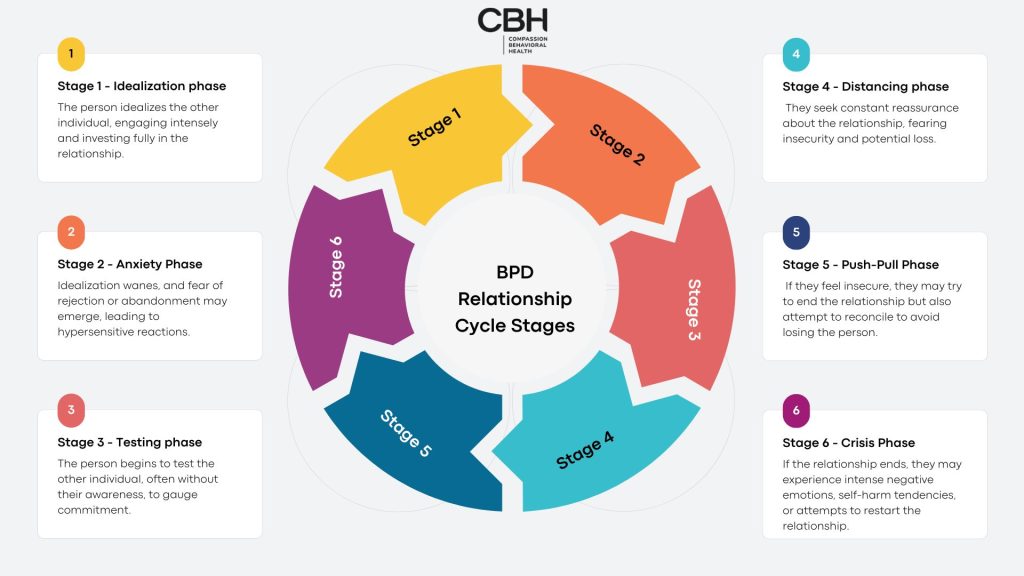
BPD Relationship Patterns: Common Features Across Relationships
The BPD relationship cycle produces several characteristic patterns that recur across different relationships for people with BPD.
Fear of Abandonment Driving Abandonment
The fear of abandonment is so central to BPD that it paradoxically produces behaviors that increase the likelihood of the abandonment being feared. Accusations, emotional intensity, impulsive actions taken in response to perceived rejection, and the push-pull of closeness and withdrawal all place strain on relationships that can eventually cause partners to leave. The pattern of losing important relationships then reinforces the belief that abandonment is inevitable, which intensifies the fear in subsequent relationships.
Intense Initial Connection
Many people with BPD describe a pattern of falling intensely in love or forming immediate deep connections with new partners or friends. The vulnerability and openness that BPD produces in the idealization phase can create a sense of unprecedented closeness that is genuinely felt, not performed. The problem is that this intensity can move faster than the relationship can sustain and can leave the other person feeling overwhelmed or idealization-to-devaluation, later, when devaluation begins, confused about what happened to the connection they experienced.
Testing Behaviors
Testing behaviors, actions taken to check whether the other person will stay or leave, whether they are as safe and committed as they seem, are common in BPD relationships. These may include picking fights, making demands, creating situations that require the partner to demonstrate loyalty, or threatening to leave before being left. These behaviors are attempts to resolve the underlying uncertainty about whether the attachment is safe.
Relationships as Identity
For some people with BPD, relationships function as a primary source of identity and sense of self. The instability of self-image that is a core feature of BPD means that who they are can feel dependent on who they are to the other person. This makes the stakes of any relational disruption feel existential rather than merely painful.
Stages of BPD Episodes: Understanding the Emotional Arc
BPD episodes, periods of intense emotional dysregulation triggered by interpersonal stressors, follow a recognizable arc for many people with the condition.
Trigger Phase
An episode typically begins with a trigger, often interpersonal: a perceived slight, a sign of distance, a misread communication, a conflict. The trigger is processed by an emotional brain that is significantly more reactive than average. The perceived threat activates the fear of abandonment system with an intensity that is disproportionate to the objective trigger from an outside perspective, but that reflects the deeply learned threat response from earlier relational experience.
Escalation Phase
The emotional intensity escalates rapidly. Thoughts become increasingly black-and-white. The integrated view of the other person collapses into splitting. Impulsive behaviors may occur during this phase: intense communication, accusations, self-destructive behavior, or abrupt withdrawal. The person in the escalation phase often reports feeling unable to access rational thinking or to remember that things were different before the trigger.
Peak Phase
The emotional intensity reaches its peak. This is the phase most likely to involve the behaviors that are most alarming and confusing to others: suicidal ideation, self-harm, explosive anger, or complete emotional shutdown. The person in the peak phase is experiencing a level of psychological pain that is genuine and acute, not performed.
De-escalation Phase
Gradually, the emotional intensity begins to reduce. The black-and-white thinking begins to soften. The person may begin to feel shame about what occurred during the escalation and peak phases, which can itself trigger another cycle of distress.
Repair Phase
In relationships, the repair phase involves reconnection attempts. Apologies, expressions of love, and efforts to rebuild the connection that was disrupted. If the repair is successful, idealization often resumes, and the cycle begins again.,
BPD Treatment: What Actually Helps
BPD is one of the most treatable personality disorders when the right clinical approach is used. The research is clear that Dialectical Behavior Therapy is the most evidence-supported treatment for BPD, with demonstrated effectiveness for reducing suicidal behavior, self-harm, emotional dysregulation, and interpersonal difficulties.
Dialectical Behavior Therapy (DBT)
DBT was developed specifically for BPD by Dr. Marsha Linehan, who has spoken publicly about her own experience with BPD. It is structured around four skill modules that directly address the features of BPD: mindfulness, which builds the capacity to observe emotional states without being controlled by them; distress tolerance, which provides skills for surviving emotional crises without destructive behavior; emotional regulation, which builds the capacity to understand and modulate intense emotional responses; and interpersonal effectiveness, which provides specific skills for navigating relationships in ways that are less likely to trigger the idealization-devaluation cycle.
DBT also directly addresses splitting through the dialectical principle: learning to hold contradictory truths simultaneously, to find synthesis rather than collapsing into all-good or all-bad thinking. This is the cognitive skill that most directly interrupts the mechanism driving the BPD relationship cycle.
Schema Therapy and Attachment-Focused Approaches
Schema therapy addresses the early maladaptive schemas, deeply held beliefs about the self and relationships formed in early life, that underlie BPD. For BPD, these often include schemas of abandonment, emotional deprivation, defectiveness, and subjugation. Addressing these schemas directly can produce changes in relational patterns that DBT skills training alone may not fully reach.
DBT at CBH in South Florida
CBH delivers DBT across its South Florida residential and outpatient programs as a core component of BPD treatment. The foundational skills are built during residential treatment in Hollywood. PHP and IOP in Fort Lauderdale deepen the work and apply it to real-world relational situations. Family therapy begins at the PHP level, addressing the relational system around the client’s recovery and providing psychoeducation to partners and family members who are navigating the relationship cycle alongside the person with BPD.
Getting the right treatment for BPD changes the relationship cycle. Not by eliminating the capacity for intense connection, which is often one of the most genuine and beautiful things about people with BPD, but by building the skills to navigate that intensity without the destructive consequences. CBH’s South Florida DBT program is designed for exactly this. Call 844-503-0126.
Frequently Asked Questions: BPD and Relationships
What is the BPD relationship cycle?
The BPD relationship cycle refers to the recurring pattern of idealisation, devaluation, and often discard that characterises many romantic and close relationships for people with borderline personality disorder. In the idealisation phase, a new partner is seen as perfect, and the person with BPD invests intensely. When the inevitable disappointment or perceived abandonment occurs, devaluation sets in; the partner is seen as all-bad. This cycle is driven by the BPD core features of black-and-white thinking (splitting), intense fear of abandonment, and unstable self-image, and it typically repeats across relationships rather than being unique to one person.
What are the stages of the BPD relationship cycle?
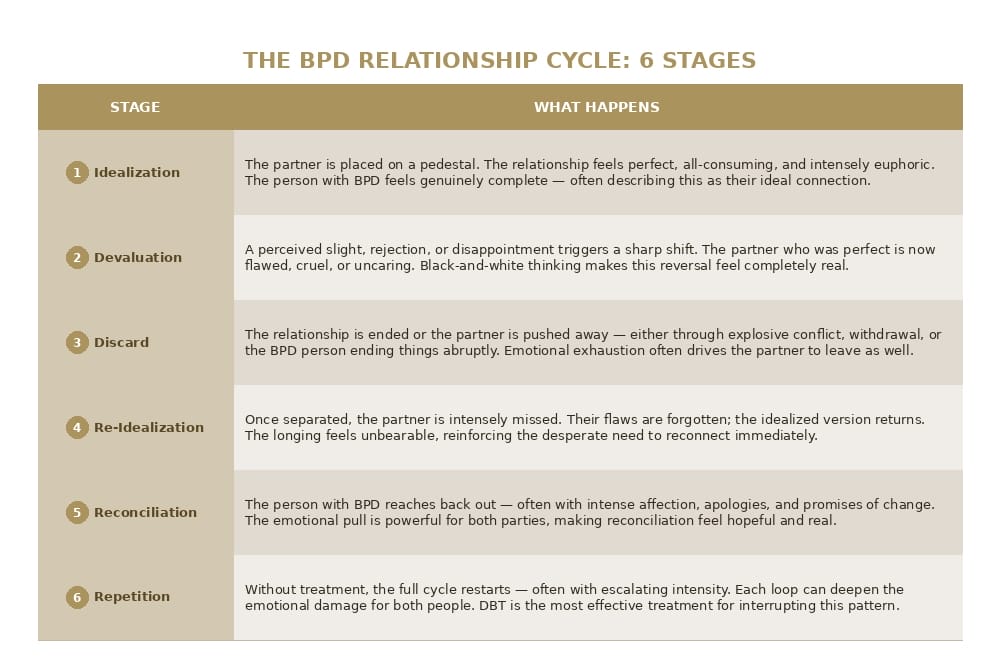
While descriptions vary, the BPD relationship cycle is most commonly described as moving through four to seven stages: idealisation (the partner is perfect, love bombing is common), anxiety (fear of abandonment begins to surface), devaluation (the partner is seen as all-bad, criticism and conflict intensify), discard or withdrawal (the person with BPD distances themselves or ends the relationship), and often a return or reconciliation, which restarts the cycle. Not every relationship follows every stage, and the duration of each phase varies widely depending on the individual and the relationship dynamic.
What are the BPD cycle stages specifically?
The BPD cycle stages most commonly identified are: the honeymoon or idealisation stage (intense connection, love bombing, the partner feels special), the tension-building stage (minor conflicts and anxiety about abandonment begin), the crisis or devaluation stage (splitting occurs, the partner is seen as all-bad, emotional outbursts or withdrawal increase), the reconciliation stage (remorse, reconnection, and a return to idealisation), and the calm or stability stage before the cycle repeats. The speed at which someone moves through these stages varies considerably; some cycles last weeks, others months.
How long does the average BPD relationship last?
Research and clinical observation suggest that relationships where one partner has BPD tend to be shorter on average than the general population, with many lasting between one and three years before the cycle of idealisation and devaluation becomes unsustainable. However, this varies significantly; many people with BPD maintain long-term relationships, particularly when receiving effective treatment such as DBT. The quality of the relationship, the partner’s own emotional resilience, and whether the person with BPD is in treatment are all stronger predictors of relationship duration than the diagnosis alone.
What does a BPD episode look like in a relationship?
A BPD episode in a relationship typically involves a rapid and intense shift in mood, perception, or behaviour triggered by a real or perceived threat, most commonly a fear of abandonment or rejection. This can manifest as sudden anger or rage disproportionate to the trigger, emotional withdrawal or stonewalling, accusations, desperate attempts to prevent the partner from leaving, or self-destructive behaviour. Episodes typically last from a few hours to a few days and are often followed by remorse or a return to the idealisation phase, which can create a confusing push-pull dynamic for the partner.
What is the BPD push-pull cycle in relationships?
The BPD push-pull cycle describes the pattern in which a person with BPD alternates between pulling their partner close, through intense affection, idealisation, and need for closeness, and pushing them away through devaluation, withdrawal, or conflict. This dynamic is driven by the simultaneous fear of abandonment (which drives the pull) and fear of engulfment or loss of self (which drives the push). Partners often find this cycle deeply confusing and exhausting, as the rules of the relationship feel unstable and their sense of security fluctuates constantly.
Does BPD affect friendships the same way it affects romantic relationships?
Yes. The BPD relationship cycle applies to close friendships as well as romantic relationships, though it is most commonly discussed in the context of romantic partnerships. Friendships with someone who has BPD can follow the same idealisation-devaluation pattern, with the friend initially elevated to “favourite person” status and then devalued when they fail to meet the intense emotional expectations the role creates. The BPD friendship cycle is often reported as particularly disorienting because most people don’t expect the same level of intensity or instability in friendships as in romantic relationships.
What is the BPD friendship cycle specifically?
The BPD friendship cycle typically begins with intense connection; the new friend is idealised as uniquely understanding, and the person with BPD may share deeply personal information early or express very strong affection quickly. Over time, when the friend inevitably disappoints or isn’t available in the way needed, devaluation can set in rapidly; the once exceptional friend becomes a source of hurt or anger. Friendships with a favourite person are most vulnerable to this pattern. With awareness and treatment, many people with BPD learn to manage this cycle and build more stable friendships over time.
What is the BPD abuse cycle?
The BPD abuse cycle refers to the pattern of emotional dysregulation and relationship instability that can, in some cases, result in behaviours that feel abusive to partners, including rage episodes, emotional manipulation, verbal attacks, and rapid devaluation. It is important to distinguish between the distress-driven behaviour patterns associated with BPD (which are symptoms of a disorder and not intentional) and deliberate abuse. Not all people with BPD are abusive, and the majority do not intentionally harm their partners. However, when BPD is untreated and combined with other factors, the relationship cycle can create real harm and trauma for both parties.
What are the BPD relationship patterns in terms of idealisation and devaluation?
Idealisation and devaluation are the two poles of the splitting dynamic that characterises BPD relationship patterns. In idealisation, the partner is seen as entirely good, perfect, uniquely understanding, and essential to the person with BPD’s wellbeing. This phase can feel intensely loving and exciting for the partner. Devaluation occurs when the person with BPD perceives disappointment, abandonment, or rejection; the partner is then seen as entirely bad, the source of all hurt. This black-and-white perception of people (splitting) is a core BPD feature and drives much of the instability in relationships.
What are the 7 stages of the BPD relationship cycle?
The 7-stage model of the BPD relationship cycle commonly described includes: idealisation (the partner is perfect), anxiety (fear of abandonment surfaces), testing (the person with BPD tests their partner’s commitment through conflict or provocative behaviour), devaluation (the partner is seen as all-bad), rage or withdrawal (emotional crisis or distance), reconciliation (remorse and reconnection), and a return to calm or idealisation before the cycle repeats. Not every relationship follows all seven stages in sequence, and the model is a framework for understanding rather than a rigid clinical description.
What are the 4 stages of BPD?
The 4-stage model most commonly associated with BPD in the context of relationships describes: idealisation (intense bonding and love bombing), anxiety and testing (fear of abandonment drives conflict or clinginess), devaluation (the partner shifts from all-good to all-bad in the person’s perception), and discard or distancing (the relationship is ended or the person with BPD withdraws). This model overlaps with the more detailed 7-stage descriptions and is a simplified framework rather than a clinical diagnostic criterion. BPD is defined by nine DSM-5 criteria, not a stage model.
How does BPD affect romantic relationships?
BPD affects romantic relationships primarily through four core symptom clusters: intense fear of abandonment (which can drive clingy, controlling, or pre-emptive rejection behaviour), splitting (black-and-white thinking that makes partners feel they are either perfect or terrible), emotional dysregulation (intense and rapidly shifting moods that create an unstable relational environment), and unstable sense of self (which affects relationship identity and role). These features create the characteristic cycle of intense connection followed by conflict and disengagement. With effective treatment, particularly DBT, many people with BPD develop the skills to maintain stable and fulfilling romantic relationships.
What are the BPD relationship patterns that partners should recognize?
Partners of someone with BPD commonly recognise several recurring patterns: love bombing and intensity early in the relationship, hypersensitivity to perceived slights or abandonment, rapid shifts between idealising and criticising the partner, fear of the relationship ending combined with behaviour that pushes the partner away, difficulty with conflict that doesn’t escalate, and recurring reconciliation cycles after ruptures. Recognising these as BPD symptoms rather than character flaws helps partners respond more effectively and reduces mutual harm. Couples therapy and individual DBT for the partner with BPD can significantly improve relational stability.
What is BPD splitting in relationships?
BPD splitting is a psychological defence mechanism in which people, experiences, or oneself are perceived as entirely good or entirely bad, with no middle ground. In relationships, splitting causes the partner to oscillate rapidly between being idealised (seen as perfect and essential) and devalued (seen as harmful or worthless) based on a single action or perceived slight. This is not a conscious choice but a symptom of the emotional and cognitive dysregulation characteristic of BPD. Splitting is one of the primary drivers of the idealisation-devaluation cycle and is one of the main targets of DBT treatment.
How do BPD relationships typically end?
BPD relationships most commonly end in one of three ways: a discard initiated by the person with BPD following a devaluation episode, a gradual deterioration caused by accumulated conflict and emotional exhaustion on the partner’s side, or mutual withdrawal following a period of intense volatility. It is also common for relationships to cycle through multiple apparent endings and reconciliations before a final separation. Breakups are typically more difficult for people with BPD due to intense abandonment fears, and the post-breakup period can involve significant distress, pursuit behaviour, or rapid entry into a new relationship.
What is the BPD breakup cycle?
The BPD breakup cycle refers to the pattern in which a relationship ends, often dramatically, and is then followed by reconciliation, which restarts the idealisation-devaluation cycle. A person with BPD may initiate a breakup during a devaluation episode, then experience intense regret and fear of abandonment once the partner withdraws, leading to reconnection. This on-off dynamic is common and can repeat many times before a final separation. Both parties are typically significantly affected by this pattern, and therapeutic support for both individuals is strongly recommended.
Can a relationship with someone with BPD be healthy?
Yes, many people with BPD maintain healthy, stable, and fulfilling relationships, particularly when they are engaged in effective treatment such as DBT (dialectical behaviour therapy). The relationship cycle described in clinical literature represents the untreated or undertreated presentation. With skills development in emotional regulation, distress tolerance, and interpersonal effectiveness, all core DBT components, the intensity and frequency of the idealisation-devaluation cycle can be reduced significantly. Partners who are informed about BPD, maintain healthy boundaries, and access their own support (such as NAMI family education programmes) also significantly improve relationship outcomes.
What is the BPD’s favourite person dynamic?
The BPD favourite person (FP) dynamic describes the intense, often overwhelming attachment that many people with BPD form with a single person, usually a romantic partner, close friend, or therapist, who becomes the primary source of emotional regulation and sense of self. The favourite person is idealised to an extreme degree, and their actions, moods, and availability have a disproportionate impact on the person with BPD’s emotional state. When the favourite person is unavailable or perceived as withdrawing, intense anxiety, anger, or self-destructive behaviour can follow. This dynamic is not exclusive to romantic relationships and is one of the most recognisable features of the BPD relationship cycle.
How does BPD idealization and devaluation affect the partner?
Being on the receiving end of BPD idealisation and devaluation is commonly described by partners as deeply disorienting and emotionally exhausting. During idealisation, partners often feel uniquely seen and loved; the intensity of the connection can be compelling and feel unlike any previous relationship. During devaluation, the same partner may experience sudden criticism, withdrawal, accusations, or rejection that feels entirely disconnected from reality. Over time, this unpredictability can erode the partner’s sense of security, self-esteem, and emotional well-being. Partners frequently benefit from individual therapy to process their own experiences and establish healthy boundaries.
Does BPD cycling affect the menstrual cycle or worsen at certain times?
There is emerging clinical evidence that BPD symptoms, particularly emotional dysregulation and mood instability, can intensify in the premenstrual phase of the menstrual cycle. This is thought to be related to the effect of hormonal fluctuations on serotonin and GABA systems, which are already dysregulated in BPD. Many women with BPD report that their emotional episodes are more frequent or intense in the week before menstruation. This overlap between PMDD (premenstrual dysphoric disorder) and BPD is an active area of research, and clinicians increasingly screen for both conditions together in female patients presenting with severe mood dysregulation.
Are there levels or types of BPD that affect how the relationship cycle presents?
BPD is not formally classified into levels in the DSM-5, but clinicians commonly distinguish between presentations based on severity and symptom profile. The four informal subtypes most discussed are: discouraged BPD (more withdrawn, passive, and clinging), impulsive BPD (more risk-taking and seductive), petulant BPD (more unpredictable anger and mood swings), and self-destructive BPD (more self-harm and self-blame). Each subtype presents somewhat differently in relationships; impulsive and petulant subtypes tend to produce more visible conflict cycles, while discouraged subtypes may internalise the cycle more. The severity of symptoms also varies considerably, from mild to severe functional impairment.
What treatment helps with the BPD relationship cycle?
Dialectical behaviour therapy (DBT) is the gold-standard evidence-based treatment for BPD and directly addresses the relationship cycle by building four core skill sets: mindfulness (observing emotions without acting on them), distress tolerance (surviving crises without making them worse), emotional regulation (understanding and managing intense emotional responses), and interpersonal effectiveness (communicating needs and setting boundaries without damaging relationships). DBT has been shown in clinical trials to significantly reduce the frequency and intensity of idealisation-devaluation cycles, self-harm, and relationship crises. Schema therapy and mentalisation-based treatment (MBT) are additional evidence-based approaches with strong outcomes for BPD.
What is the BPD relationship cycle?
The BPD relationship cycle is a pattern of alternating idealization and devaluation in close relationships that is characteristic of Borderline Personality Disorder. The cycle typically begins with intense idealization, a sense that the other person is perfect and the relationship is the one that will finally feel safe. When the other person inevitably demonstrates normal human imperfections or perceived signs of distance, the idealization collapses into devaluation, driven by fear of abandonment and the splitting mechanism that characterizes BPD. The cycle then moves through conflict or withdrawal, repair, and often a return to idealization.
What are the stages of BPD?
The stages of the BPD relationship and episode cycle typically include: idealization, in which the other person or relationship is experienced as perfect; anxiety and sensitivity, in which small signs of distance begin to feel threatening; devaluation, in which the idealized image collapses through splitting; conflict or withdrawal; fear of abandonment, often producing paradoxical push-pull behavior; and reconnection or relationship ending. BPD episodes follow a similar arc: trigger, escalation, peak, de-escalation, and repair.
What is the idealization to devaluation cycle in BPD?
The idealization to devaluation cycle in BPD is the oscillation between seeing someone as all good and all bad, driven by a cognitive mechanism called splitting. In the idealization phase, the other person can do no wrong and the relationship feels uniquely safe and special. When a trigger activates the fear of abandonment, splitting causes the integrated view of the person to collapse: the same person who was perfect is now experienced as entirely disappointing or dangerous. This shift is neurological rather than deliberate and reflects the heightened emotional reactivity and early relational trauma that underlie BPD.
What does BPD in relationships look like?
BPD in relationships often involves intense initial connection and idealization, followed by episodes of devaluation and conflict when the fear of abandonment is triggered. Partners may describe feeling loved and rejected within the same day, walking on eggshells to avoid triggering emotional episodes, and experiencing a push-pull dynamic of intense closeness and sudden withdrawal. The person with BPD is often genuinely distressed by these patterns and aware that they are causing harm in relationships but may lack the skills to respond differently without targeted treatment.
Is BPD treatable?
Yes. BPD is one of the most treatable personality disorders with the right clinical approach. Dialectical Behavior Therapy, developed specifically for BPD by Dr. Marsha Linehan, has the strongest evidence base of any BPD treatment and produces significant reductions in suicidal behavior, self-harm, emotional dysregulation, and interpersonal difficulties. Research shows that most people with BPD who receive appropriate treatment experience substantial improvement and many achieve remission of symptoms. Early, appropriate treatment improves the prognosis significantly.
Does CBH treat BPD in South Florida?
Yes. CBH treats Borderline Personality Disorder within its South Florida residential and outpatient programs. DBT is a core modality delivered across the residential program in Hollywood and the PHP and IOP programs in Fort Lauderdale. CBH’s DBT program addresses all four skill modules: mindfulness, distress tolerance, emotional regulation, and interpersonal effectiveness, alongside individual therapy, group therapy, psychiatric medication management, and family therapy. Call 844-503-0126 for a free clinical assessment.

The Cycle Can Change
The BPD relationship cycle is not a life sentence. It is the expression of a nervous system that learned a particular way of attaching in the context of early relational pain, and it can be changed through the right clinical approach. DBT gives people with BPD the specific skills to observe their emotional states before acting on them, to tolerate the intensity of the fear without the destructive behaviors that have cost them relationships, and to develop a more stable and integrated sense of self that does not depend on the other person being perfect.
People with BPD are often among the most sensitive, empathic, and intensely feeling people that exist. The goal of treatment is not to reduce that capacity but to build the skills that allow it to be present without the devastation that comes when it operates without any containment.
If you or someone you love is living with BPD or with the relational patterns described in this article, CBH’s South Florida clinical team is here. Call 844-503-0126. Available 24 hours a day, seven days a week. All calls are completely confidential. Stories change here.


