

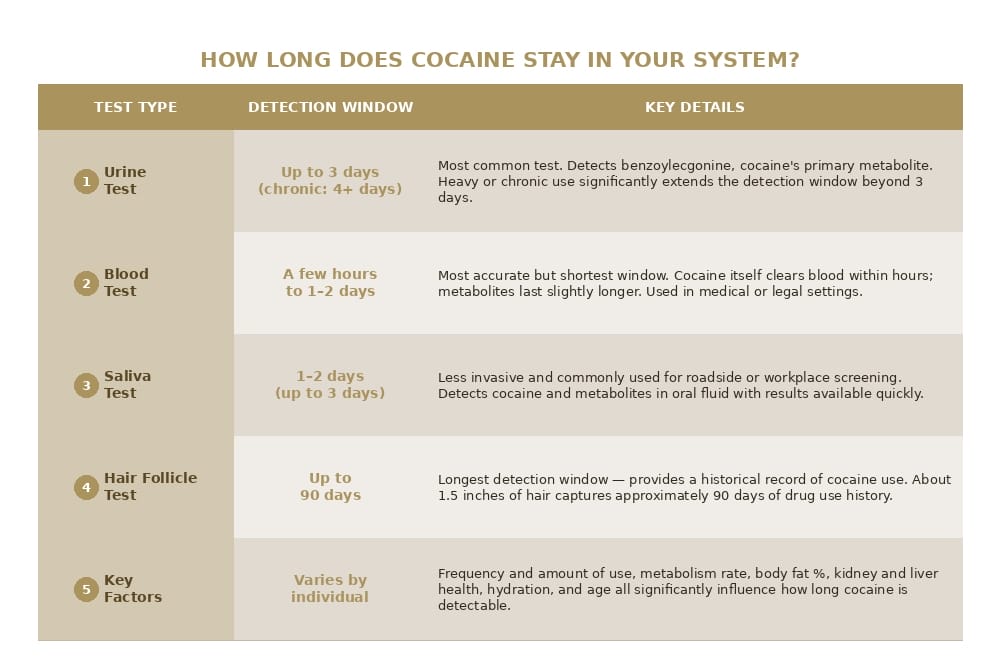
Cocaine is detectable in the body for different lengths of time depending on which test is used. Urine tests detect cocaine metabolites for two to four days after last use in most people. Blood tests detect cocaine itself for approximately 12 hours. Saliva tests detect cocaine for one to two days. Hair follicle tests can detect cocaine metabolites for up to 90 days.
These are general ranges. The actual detection window for any individual depends on several factors: how much cocaine was used, how frequently it was used, the individual’s metabolism, body fat percentage, kidney and liver function, and the sensitivity threshold of the specific test being used. A single use by a first-time user will clear much faster than the same amount used by someone who uses regularly.
If you are searching for this information because cocaine use has become a pattern rather than an isolated event, or because the prospect of a drug test has created anxiety about consequences, CBH’s South Florida team is available at 844-503-0126. All calls are completely confidential.
Cocaine Detection Time Chart: All 4 Test Types
The table below summarizes cocaine detection windows by test type for casual, moderate, and heavy users.
| Use Pattern | Urine | Blood | Saliva | Hair |
| Single use | 2-3 days | Up to 12 hrs | Up to 1 day | Up to 90 days |
| Moderate use | 3-5 days | Up to 12 hrs | 1-2 days | Up to 90 days |
| Heavy/chronic use | Up to 14 days | Up to 12 hrs | Up to 2 days | Up to 90 days |
| Benzoylecgonine* | 2-4 days | 5-6 hrs | 1-2 days | Up to 90 days |
*Benzoylecgonine is the primary cocaine metabolite tested in most standard drug screens. It is produced when the body breaks down cocaine and remains detectable longer than cocaine.

Test 1: Urine Test (Urinalysis)
Urine testing is the most common drug test method used by employers, courts, probation officers, and treatment programs. It does not test for cocaine directly. It tests for benzoylecgonine, the primary metabolite the body produces when processing cocaine.
How Long Does Cocaine Stay in Urine?
Cocaine metabolites are typically detectable in urine for two to four days after last use for occasional users. Moderate users may test positive for three to five days. Heavy or chronic users can test positive for up to two weeks. The standard cutoff threshold for a positive urine cocaine test is 300 nanograms per milliliter (ng/mL) on the initial screen, confirmed at 150 ng/mL on confirmation testing.
Factors That Affect Urine Detection Time
- Frequency of use: occasional users clear cocaine metabolites faster than chronic users because the metabolites have not accumulated in body tissues
- Dose: larger amounts of cocaine produce more benzoylecgonine, extending detection time
- Metabolism: people with faster metabolisms process and excrete metabolites more quickly
- Hydration: adequate hydration supports kidney function and metabolite excretion, but extreme overhydration does not reliably produce a negative result and may flag a diluted sample
- Kidney and liver function: impaired kidney or liver function slows metabolite clearance
- Body fat percentage: cocaine metabolites are fat-soluble and can accumulate in adipose tissue, extending detection in people with higher body fa
Test 2: Blood Test
Blood tests detect cocaine itself rather than its metabolites, making them the most accurate indicator of very recent use. They are also the most invasive and the most rapidly cleared.
How Long Does Cocaine Stay in Blood?
Cocaine is typically detectable in blood for approximately 12 hours after last use. Benzoylecgonine, the primary metabolite, is detectable in blood for approximately five to six hours. Blood tests are rarely used for routine employment screening because of their short detection window and invasive collection requirements. They are more commonly used in emergency medical situations, accident investigations, and forensic contexts where very recent use is the relevant question.
Roadside Drug Tests and Blood
Law enforcement roadside drug tests in Florida and across the United States may use saliva swab tests rather than blood draws for initial roadside screening. Blood draws typically require a warrant or a hospital setting in Florida. If you are concerned about a roadside drug test following cocaine use, the saliva detection window of one to two days is more relevant than the blood detection window for roadside screening purposes in most jurisdictions.
Test 3: Saliva Test (Oral Fluid Test)
Saliva testing, also called oral fluid testing, has become more common for roadside law enforcement testing, workplace testing, and some treatment program monitoring because of its non-invasive collection and ability to detect very recent use.
How Long Does Cocaine Stay in Saliva?
Cocaine is typically detectable in saliva for one to two days after last use. Saliva tests are particularly sensitive to recent use within the past few hours, making them a common choice for roadside testing where the relevant question is whether someone has used cocaine recently enough to be impaired. The detection window is shorter than urine testing, which makes saliva testing less useful for detecting past use but more useful for detecting use that occurred within the last day or two.
How Long Does Cocaine Stay in System for Roadside Test?
For a roadside saliva-based drug test, cocaine is typically detectable for one to two days after last use. For a roadside blood draw, cocaine itself is detectable for approximately 12 hours. In Florida, law enforcement may use saliva swab tests for initial roadside screening. A positive saliva screen may be followed by a confirmatory blood draw with a warrant. If you used cocaine within the last 24 to 48 hours and are concerned about a roadside drug test, the saliva detection window is the most relevant figure for most roadside testing scenarios.
Test 4: Hair Follicle Test
Hair follicle testing provides the longest detection window of any drug test type and is the most difficult to avoid. It is commonly used by employers for pre-employment screening, courts, custody cases, and situations where a longer history of drug use is relevant.
How Long Does Cocaine Stay in Hair?
Cocaine metabolites are detectable in hair follicle tests for up to 90 days after last use, though the standard test examines the most recent 1.5 inches of hair growth, which corresponds to approximately 90 days of growth. Because hair grows at approximately half an inch per month, a hair follicle test provides a roughly three-month history of substance use. Heavy or chronic cocaine use may produce detectable metabolites for longer periods depending on hair length and testing methodology.
Hair follicle tests cannot detect use that occurred within the past seven to ten days because it takes time for metabolites to be incorporated into the growing hair shaft. This means a hair test is not useful for detecting very recent use but is the most reliable method for establishing a pattern of use over the preceding months.
How Long Does Cocaine Take to Test Negative?
This is one of the most commonly searched questions about cocaine and drug testing, and the answer depends on which test is used.
Urine Test: 2 to 14 Days
For occasional users, a urine test will typically return negative two to four days after last cocaine use. For moderate users, three to five days. For heavy or chronic users, up to two weeks. The most accurate way to know when a urine test will return negative is to understand your own use pattern and compare it to the detection windows above.
Blood Test: 12 to 24 Hours
Blood tests will typically return negative within 12 to 24 hours of last cocaine use for most people. This is the shortest detection window of any common drug test.
Saliva Test: 1 to 2 Days
Saliva tests will typically return negative one to two days after last cocaine use. Occasional users may clear faster. Chronic users may remain detectable for the full two days.
Hair Test: 90 Days Plus
A hair-follicle test will not return a negative result until either sufficient time has passed for new, uncontaminated hair to grow out to the tested length or the hair containing the metabolites is cut off. For most standard hair tests that examine 1.5 inches of hair, clearing a hair test requires approximately 90 days without cocaine use.
If the question of how long it takes to test negative is connected to an upcoming court date, probation test, employment screening, or other consequence of cocaine use, it may be worth considering whether the pattern of use itself has become something that needs professional support. CBH’s admissions team is available at 844-503-0126. All calls are completely confidential.
Factors That Affect How Long Cocaine Stays in Your System
Detection windows are averages. The following factors determine where any individual falls within those ranges.
Frequency and Amount of Use
This is the most significant factor. A single use of a small amount of cocaine produces relatively little benzoylecgonine and clears quickly. Chronic heavy use produces large amounts of benzoylecgonine that accumulate in body tissues, particularly fat cells, and takes significantly longer to clear. Daily cocaine use can extend urine detection windows to two weeks or more.
Method of Use
Snorting cocaine produces a slower absorption rate than smoking crack cocaine or injecting cocaine. The route of administration affects how quickly cocaine reaches peak blood concentration and how rapidly the body begins processing it. Smoking and injection produce faster peaks and potentially faster initial clearance of cocaine itself, though the metabolite clearance timeline is similar across methods.
Metabolism and Body Composition
Individual metabolic rate affects how quickly the liver processes cocaine and how quickly the kidneys excrete its metabolites. People with higher body fat percentages may retain metabolites longer because benzoylecgonine is fat-soluble and can accumulate in adipose tissue. Liver and kidney health significantly affects clearance speed.
Age and Overall Health
Metabolic rate tends to slow with age, which can extend cocaine clearance times. Overall liver and kidney health, hydration status, and other individual health factors all influence detection windows.
Co-occurring Substance Use
Using cocaine with alcohol produces a third compound called cocaethylene, which is also detectable in drug tests and has a longer half-life than cocaine alone. Regular concurrent alcohol and cocaine use can extend the detection window compared to cocaine use alone.

How to Pass a Drug Test for Cocaine
There is no reliable, verified method to pass a properly administered cocaine drug test before the detection window has elapsed.
Common claims include drinking large amounts of water to dilute urine, using detox drinks or supplements, and substituting clean urine. None of these methods reliably produce a negative result on a properly administered test. Extreme overhydration can dilute creatinine and specific gravity in urine to levels that flag the sample as diluted, which in many testing contexts is treated the same as a positive result or requires a retest. Synthetic urine and substitution attempts are detected by temperature checks and validity testing in monitored collections. Hair follicle tests are essentially impossible to falsify.
The only reliable way to pass a cocaine drug test is to not use cocaine for long enough that the substance clears your system naturally. If that timeline creates significant consequences, or if stopping cocaine use entirely feels difficult or impossible, that information is clinically significant.
If cocaine use has become difficult to control, or if the consequences of continued use, including failed drug tests, are mounting, CBH’s South Florida team can help. Call 844-503-0126. All conversations are completely confidential. Our admissions team is available around the clock.
What Cocaine Does to the Brain and Body
Understanding why cocaine is difficult to stop using requires understanding what it does neurologically. Cocaine blocks the reuptake of dopamine, serotonin, and norepinephrine at the synapse, producing a rapid and intense buildup of these neurotransmitters. The dopamine surge produces the intense euphoria, energy, and confidence associated with cocaine use.
With repeated use, the brain’s reward system adapts to the artificial dopamine elevation by reducing its own baseline dopamine production and reducing the sensitivity of dopamine receptors. The result is tolerance: the same amount of cocaine produces less effect, requiring more cocaine to achieve the same state. It also produces a baseline state between uses that is characterized by anhedonia, fatigue, dysphoria, and difficulty experiencing pleasure from ordinary activities. This is the neurological basis of cocaine addiction, and it is why stopping without support is so difficult for people who have used regularly.
PTSD, depression, ADHD, anxiety, and bipolar disorder all involve disruptions in the dopamine and norepinephrine systems that cocaine temporarily corrects. This is why cocaine use so commonly develops in people with these untreated mental health conditions, and why CBH’s treatment model treats the mental health condition alongside the cocaine use disorder simultaneously.
When Cocaine Use Has Become a Problem
The people searching ‘how long does cocaine stay in your system‘ are often not researchers. They are people who used cocaine recently and are worried about an upcoming drug test, a consequence, or a conversation they are not ready to have. If that describes your situation, CBH’s South Florida treatment team is not here to judge. We are here to help.
Cocaine addiction is not a character flaw. It is a clinical condition with neurological and mental health dimensions that respond to evidence-based treatment. CBH’s cocaine addiction treatment in South Florida addresses the depression, ADHD, anxiety, PTSD, or bipolar disorder that most commonly drives cocaine use alongside the cocaine use disorder itself, treating both from the first day of admission.
Our outcomes are third-party verified: 159% improvement in depression outcomes, 167% improvement in anxiety outcomes, and 88% improvement in PTSD outcomes, measured by Greenspace Health across more than 1,000 patient surveys. These are the conditions most commonly driving cocaine use in our South Florida client population.
- Residential cocaine addiction treatment in Hollywood, FL
- PHP and IOP in Fort Lauderdale, FL
- Mental health treated as the primary diagnosis alongside cocaine use disorder
- Dr. Daud, board-certified in psychiatry and addiction psychiatry, oversees all evaluations
- In-network with Aetna, Blue Cross Blue Shield, Cigna, Optum, TRICARE East, and the VA
- Insurance verified at no cost before any decisions are made
Call 844-503-0126 now. Available 24 hours a day, seven days a week. All calls are completely confidential.
Four Things to Be Concerned About Cocaine in Your System
1. Cocaine Detection in Blood
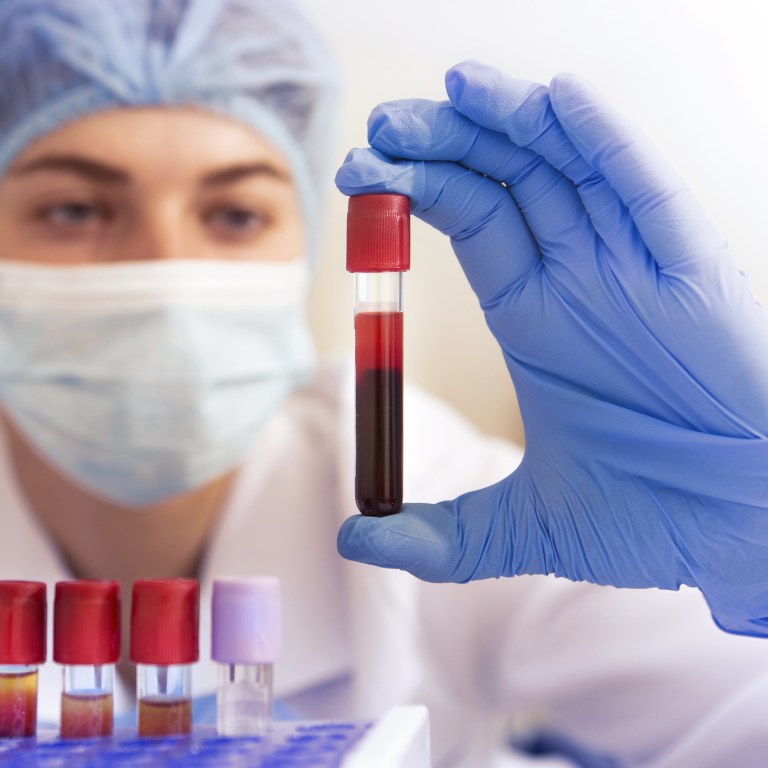
Cocaine is rapidly absorbed into the bloodstream after use, making it detectable in blood within minutes. However, the actual detection window for cocaine in the blood is relatively short, typically ranging from a few hours to a day or two. It is worth noting that the presence of cocaine in the blood alone is not necessarily indicative of impairment or recent use, as its effects may have already worn off by the time of testing.
2. Cocaine Detection in Urine
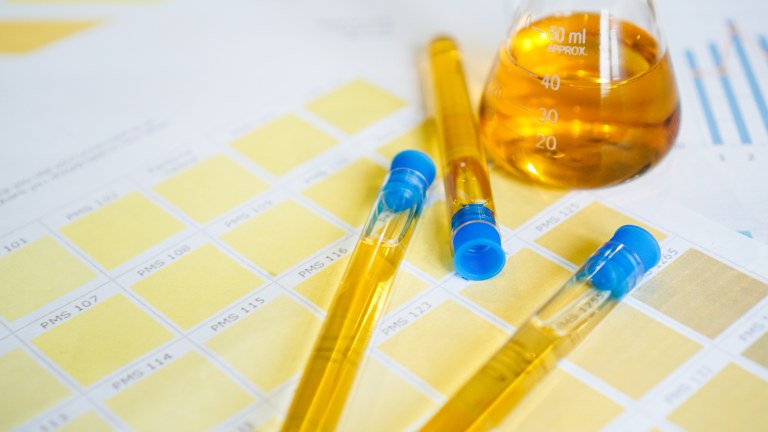
Urine testing is the most common method used to detect the presence of cocaine in the body. Cocaine and its metabolites can be detected in urine for a longer duration compared to blood testing. The detection window for cocaine in urine is usually up to 3 days after the last use but can be extended to a week or more for chronic users or in cases of heavy cocaine use.
3. Cocaine Detection in Saliva
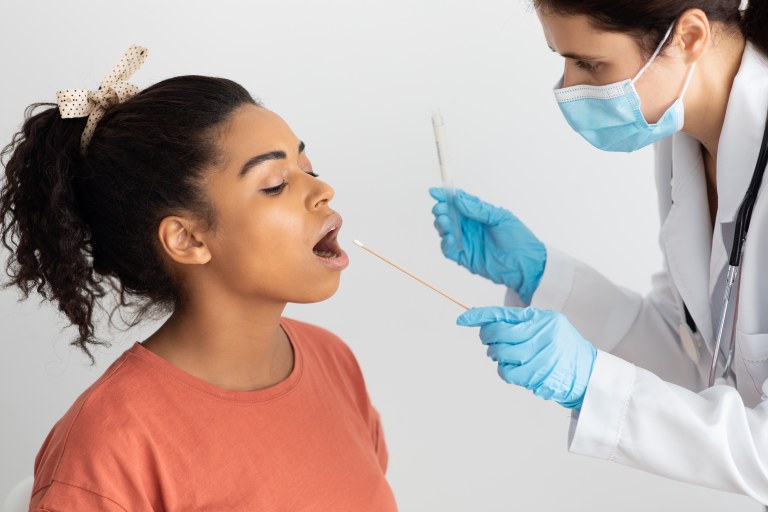
Saliva testing, also known as oral fluid testing, is another method used to detect the presence of cocaine. Cocaine and its metabolites can be detected in saliva within minutes of use and can remain detectable for up to 2-3 days. However, the detection window for cocaine in saliva is relatively short compared to other methods.
4. Cocaine Detection in Hair
Hair testing is a method used to detect long-term drug use and can provide a historical record of cocaine use. Cocaine and its metabolites can be detected in hair follicles for up to 90 days or even longer, depending on the length of the hair sample collected. However, it is important to note that hair testing is not able to determine the exact timing or frequency of drug use.
Psychological Impact of Cocaine Withdrawal
The psychological impact of cocaine withdrawal is profound and can be a significant barrier to successful recovery from addiction. Withdrawal from cocaine often triggers a range of psychological symptoms that can vary in intensity and duration, depending on the duration and intensity of use. Common psychological symptoms include depression, anxiety, irritability, extreme cravings for the drug, and vivid, unpleasant dreams. These symptoms occur because cocaine use disrupts the brain’s natural production of dopamine, leading to decreased levels when the drug is no longer used.
Potential Triggers for Relapse: Triggers for relapse during cocaine withdrawal can include exposure to environments where the individual used cocaine, social interactions with peers who use substances, stress, and encountering cues that have been previously associated with cocaine use. Emotional states such as feeling overwhelmed, anxious, or depressed also significantly contribute to relapse risks.
Strategies for Coping with Cravings
Coping with cravings during cocaine withdrawal involves multiple strategies that can be tailored to an individual’s needs. Behavioral strategies, such as distraction, engaging in exercise, or practicing relaxation techniques like deep breathing or meditation, can be effective. Additionally, cognitive-behavioral approaches help individuals reframe their thoughts about drug use and develop healthier responses to cravings and triggers.
Role of Psychological Support in Recovery Programs
Psychological support in recovery programs is crucial for addressing the complex emotional and behavioral aspects of addiction. This support often includes therapy sessions, both individual and group, that help individuals understand the psychological roots of their addiction. Therapies like Cognitive Behavioral Therapy (CBT), Dialectical Behavior Therapy (DBT), and motivational interviewing are commonly used to help manage withdrawal symptoms and reduce relapse risks. Support groups and family therapy can also provide emotional reinforcement and a sense of community, helping individuals feel less isolated in their recovery journey.
If Cocaine Use Has Become More Than You Expected
If you searched this page because cocaine use has become a pattern, because consequences are building, or because stopping feels harder than it should, you are not alone, and you do not have to figure this out by yourself.
CBH’s South Florida team treats cocaine addiction within a dual-diagnosis model that addresses the mental health conditions driving the use alongside the cocaine use disorder itself. Residential treatment in Hollywood. PHP and IOP in Fort Lauderdale. Mental health first. Outcomes verified. Insurance accepted.
Call 844-503-0126 now. Available 24 hours a day, seven days a week. All calls are completely confidential. Stories change here.
Cocaine Use Frequently Asked Questions
How long does cocaine take to test negative?
The time cocaine takes to produce a negative drug test result depends on the test type and frequency of use. In urine, occasional users typically test negative within 2–4 days, while heavy users may need 10 to 14 days. In saliva, a negative result is usually achievable within 24–48 hours. In blood, cocaine tests negative within 12–24 hours for most users. There is no guaranteed timeframe; individual metabolism, hydration, and the amount used all influence when a test turns negative.
How long does cocaine take to test negative on a mouth swab?
A mouth swab test will typically return negative for cocaine within 24–48 hours of last use for occasional users. Because saliva tests detect the parent drug rather than metabolites, cocaine clears the oral fluid relatively quickly compared to urine. Heavy or repeated use can push the saliva detection window closer to 48 hours, but for most users, a single-use event will test negative on a swab within one to two days.
How long does cocaine take to test negative in hair?
Unlike urine or saliva tests, a hair follicle test does not turn negative simply with the passage of a few days; cocaine metabolites are permanently locked into the hair shaft as it grows. The only way to test negative on a hair test is for the relevant period of use to fall outside the sample window, which covers approximately the most recent 90 days of growth. New hair growth from periods of non-use will not contain metabolites, but existing hair that has recorded cocaine use will remain positive indefinitely unless cut off.
How long is cocaine detectable in urine?
Cocaine is detectable in urine for 2 to 4 days in occasional users and up to 10 to 14 days in heavy or chronic users. Urine tests screen for benzoylecgonine, the primary metabolite produced when the liver breaks down cocaine, rather than cocaine itself. This is why the detection window extends well beyond when the drug’s effects have worn off. The standard cutoff for a positive result is 300 ng/mL on an initial screen, confirmed at 150 ng/mL.
How long is cocaine detectable in saliva?
Cocaine is detectable in saliva for approximately 1to 2 days after use. Detection can begin within minutes of use as cocaine and its metabolites enter oral fluid almost immediately. Saliva tests are particularly effective at detecting very recent use, within the past 12–24 hours, making them the preferred method for roadside and post-incident testing. For occasional users, a saliva test will typically return negative within 24 to 48 hours of last use.
How long does cocaine stay in your body overall?
The answer varies depending on where in the body you are measuring. Cocaine itself has a plasma half-life of approximately 60 minutes and is largely cleared from the blood within a few hours. Its metabolites persist longer, in urine for 2 to 14 days depending on use patterns, in saliva for 1 to 2 days, and embedded in hair for up to 90 days. The drug’s psychoactive effects last 15 to 90 minutes, but traces of its metabolites remain detectable long after any subjective effects have disappeared.
How long does cocaine stay in your system for a UA (urinalysis)?
A urinalysis for cocaine screens for benzoylecgonine at a threshold of 300 ng/mL. For occasional users, this will typically return positive for 2–4 days after use. For frequent or heavy users, defined as multiple uses per week or large single doses, the detection window extends to 10–14 days. Chronic daily users have been documented testing positive on UA for up to three weeks in some clinical studies, though this is uncommon.
How long does cocaine stay in blood work?
Cocaine itself is detectable in blood for approximately 6–12 hours after use. Its metabolite, benzoylecgonine, is detectable in blood for up to 24–48 hours, while a less common metabolite called cocaethylene, produced only when cocaine and alcohol are used together, may extend blood detectability further. Blood work for cocaine is most commonly ordered in emergency medical settings, forensic investigations, and post-accident workplace testing, where very recent use needs to be confirmed.
How long does cocaine remain above the detection threshold in the blood?
In a standard blood test, cocaine metabolites fall below the detection threshold within 12–24 hours for occasional users. For heavy users or those who use cocaine alongside alcohol, the window can extend to 48 hours due to slower metabolite clearance. Blood tests use a lower cutoff threshold than urine tests, making them more sensitive to recent use but less useful for detecting use that occurred more than 48 hours prior.
How long does cocaine show on a swab test?
A swab test can show cocaine for approximately 24 to 48 hours after use. The test detects cocaine and its metabolites in oral fluid, and because cocaine enters saliva very rapidly after use, a swab can also detect use that occurred within the last few hours, making it more effective than urine for identifying very recent consumption. Most roadside and workplace swab tests use a detection threshold of 20 to 40 ng/mL for cocaine in oral fluid.
How long does cocaine show up on a drug test generally?
The detection window for cocaine on a drug test depends entirely on which type of test is used. On a urine test, cocaine shows up for 2 to 4 days (occasional use) to 10–14 days (heavy use). On a saliva test, it shows up for 1 to 2 days. On a blood test, cocaine shows up for 12 to 48 hours. On a hair follicle test, cocaine shows up for up to 90 days. The urine test is the most commonly administered and, therefore, the most relevant reference point for most people asking this question.
How long does cocaine stay in your system for a chronic user?
For a chronic cocaine user, someone using daily or near-daily, urine detection windows can extend to 10–14 days, and in some documented cases, beyond two weeks. This extended window occurs because metabolites accumulate in fatty tissue over time and are released gradually back into the bloodstream, keeping urine concentrations above the detection threshold for much longer than for occasional users. Chronic users also tend to have higher total metabolite loads, meaning it takes longer for levels to drop below the 300 ng/mL cutoff.
How long does cocaine stay in your system for an occasional user?
For an occasional user, someone using cocaine infrequently, such as once every few weeks or less, cocaine metabolites are typically detectable in urine for 2 to 3 days after use. In saliva, an occasional user will likely test negative within 12 to 24 hours. In blood, the window is under 12 hours. Because there is no accumulation of metabolites from regular use, occasional users clear cocaine from their system significantly faster than chronic users.
How long does cocaine stay in saliva for a light user?
A light or infrequent cocaine user can typically expect a saliva test to return negative within 12 to 24 hours of last use, and in some cases, within a few hours if the dose was small. Saliva tests are concentration-dependent, so a smaller amount of cocaine produces lower oral fluid concentrations that fall below the detection threshold more quickly. This makes saliva testing less reliable for detecting light or infrequent use compared to urine testing.
How long does cocaine stay in your system for a first-time user, specifically in urine?
For a genuine first-time cocaine user, urine detection windows are typically at the shorter end of the range, around 2 to 3 days after use. Because there is no prior accumulation of metabolites in fatty tissue and the kidneys are processing a relatively modest metabolite load, first-time users generally clear cocaine faster than regular users. That said, even a single use can produce metabolite concentrations well above the 300 ng/mL threshold for the first 24 to 48 hours.
Does cocaine show up in a blood test?
Yes, cocaine and its metabolites show up in a blood test. Cocaine itself is detectable in blood for approximately 6 to 12 hours after use, while benzoylecgonine remains detectable for 24–48 hours. Blood tests for cocaine are not used in routine employment or legal drug screening due to the narrow detection window and invasive collection process, but they are standard in emergency medicine, forensic toxicology, and post-mortem investigations.
How long does cocaine in urine remain detectable for a heavy user?
For a heavy cocaine user, someone using multiple times per week or in large quantities, urine detection windows commonly extend to 10 to 14 days after the last use. This is because benzoylecgonine accumulates in fatty tissue with repeated use and is released back into the bloodstream gradually, keeping urine concentrations above the 300 ng/mL detection threshold for much longer. In rare cases involving extreme chronic use, positive urine tests have been documented beyond two weeks.
Can cocaine be detected in urine after 3 days?
For an occasional or light user, cocaine metabolites may fall below the 300 ng/mL detection threshold within 3 days, but this is not guaranteed; many occasional users will still test positive at day 3. For regular or heavy users, a positive result at 3 days is highly likely, and the detection window extends considerably beyond this point. The safest assumption is that cocaine remains detectable in urine for a minimum of 3 to 4 days for any user, regardless of usage pattern.
How long does it take for cocaine to not show up in urine?
For occasional users, cocaine typically stops showing up in urine within 2 to 4 days of last use as metabolite concentrations fall below the 300 ng/mL detection cutoff. For heavy or chronic users, this can take 10 to 14 days or longer. The timeline cannot be precisely predicted for any individual because metabolism rate, body fat, hydration, kidney function, and the total amount consumed all affect how quickly benzoylecgonine is excreted. There is no reliable method to accelerate this process.
How long does cocaine stay in your system for a swab test, specifically?
For a standard oral fluid swab test, cocaine is detectable for approximately 24–48 hours after use. The test is most sensitive to very recent use; cocaine enters saliva within minutes of administration, making swab tests particularly effective for same-day detection. After 48 hours, the vast majority of users will test negative on a swab, though this timeline can vary slightly based on hydration, the amount used, and individual salivary composition.
How long does cocaine stay in your system for a urine drug screen compared to a blood test?
The detection windows differ significantly between the two test types. In urine, cocaine metabolites are detectable for 2–4 days (occasional use) to 10–14 days (heavy use). In blood, cocaine is detectable for only 6 to 12 hours, and its metabolites for up to 48 hours. This means a blood test is far more useful for confirming very recent use, within the past day or two, while a urine test provides a much longer historical detection window and is therefore the standard for employment and legal screening.
How long does cocaine stay in your system for a urine drug test specifically?
On a standard urine drug test, cocaine metabolites are detectable for 2 to 4 days after occasional use and up to 10–14 days after heavy or chronic use. The test screens for benzoylecgonine at a cutoff of 300 ng/mL, confirmed at 150 ng/mL by GC-MS if an initial screen is positive. Urine testing is the most widely used method for cocaine detection in employment, legal, probation, and clinical settings due to its relatively long detection window, non-invasive collection process, and low cost.
How long does cocaine stay in your system?
Cocaine detection times vary by test type. In urine, cocaine metabolites are detectable for two to four days for occasional users and up to two weeks for heavy users. In blood, cocaine is detectable for approximately 12 hours. In saliva, cocaine is detectable for one to two days. In hair follicles, cocaine metabolites are detectable for up to 90 days. These are general ranges; individual factors including frequency of use, metabolism, and body composition affect actual detection windows.
How long does cocaine stay in your system for a roadside test?
For a roadside saliva-based drug test, cocaine is typically detectable for one to two days after last use. For a roadside blood draw, cocaine itself is detectable for approximately 12 hours. In Florida, law enforcement may use saliva swab tests for initial roadside screening. A positive saliva screen may be followed by a confirmatory blood draw. If you used cocaine within the last 24 to 48 hours, you may test positive on a roadside saliva screen.
How long does cocaine take to test negative?
On a urine test, cocaine typically takes two to four days to test negative for occasional users and up to two weeks for heavy or chronic users. On a blood test, cocaine typically takes 12 to 24 hours. On a saliva test, one to two days. On a hair follicle test, 90 days of abstinence is required for the tested hair segment to grow out clean, though the contaminated hair can be cut off sooner. The method of use, frequency, dose, and individual metabolism all affect the exact timeline.
How long does coke stay in your urine?
Cocaine metabolites are typically detectable in urine for two to four days after last use for occasional users. Moderate users may test positive for three to five days. Heavy or chronic users can test positive for up to two weeks. The standard urine cocaine test detects benzoylecgonine, the primary metabolite the body produces when processing cocaine, rather than cocaine itself.
Can you pass a drug test for cocaine by drinking water?
Drinking large amounts of water does not reliably produce a negative cocaine drug test result. Extreme overhydration can dilute urine to the point where creatinine and specific gravity fall below normal ranges, which flags the sample as diluted. A diluted sample is often treated the same as a positive result or requires a monitored retest. The only reliable way to pass a cocaine drug test is to allow sufficient time for cocaine metabolites to clear your system naturally.
What shows up on a cocaine drug test?
Most standard cocaine drug tests detect benzoylecgonine, the primary metabolite the body produces when processing cocaine, rather than cocaine itself. Benzoylecgonine remains detectable longer than cocaine, making urine tests effective at detecting cocaine use that occurred days before the test. Blood and saliva tests may detect cocaine directly in addition to its metabolites. Hair follicle tests detect metabolites embedded in the hair shaft.
What is a cocaine detection time chart?
A cocaine detection time chart shows estimated detection windows for cocaine and its metabolites across different test types and use patterns. For occasional use: urine 2-3 days, blood up to 12 hours, saliva up to 1 day, hair up to 90 days. For heavy or chronic use: urine up to 14 days, blood up to 12 hours, saliva up to 2 days, hair up to 90 days. These ranges are estimates; individual factors affect actual detection times.